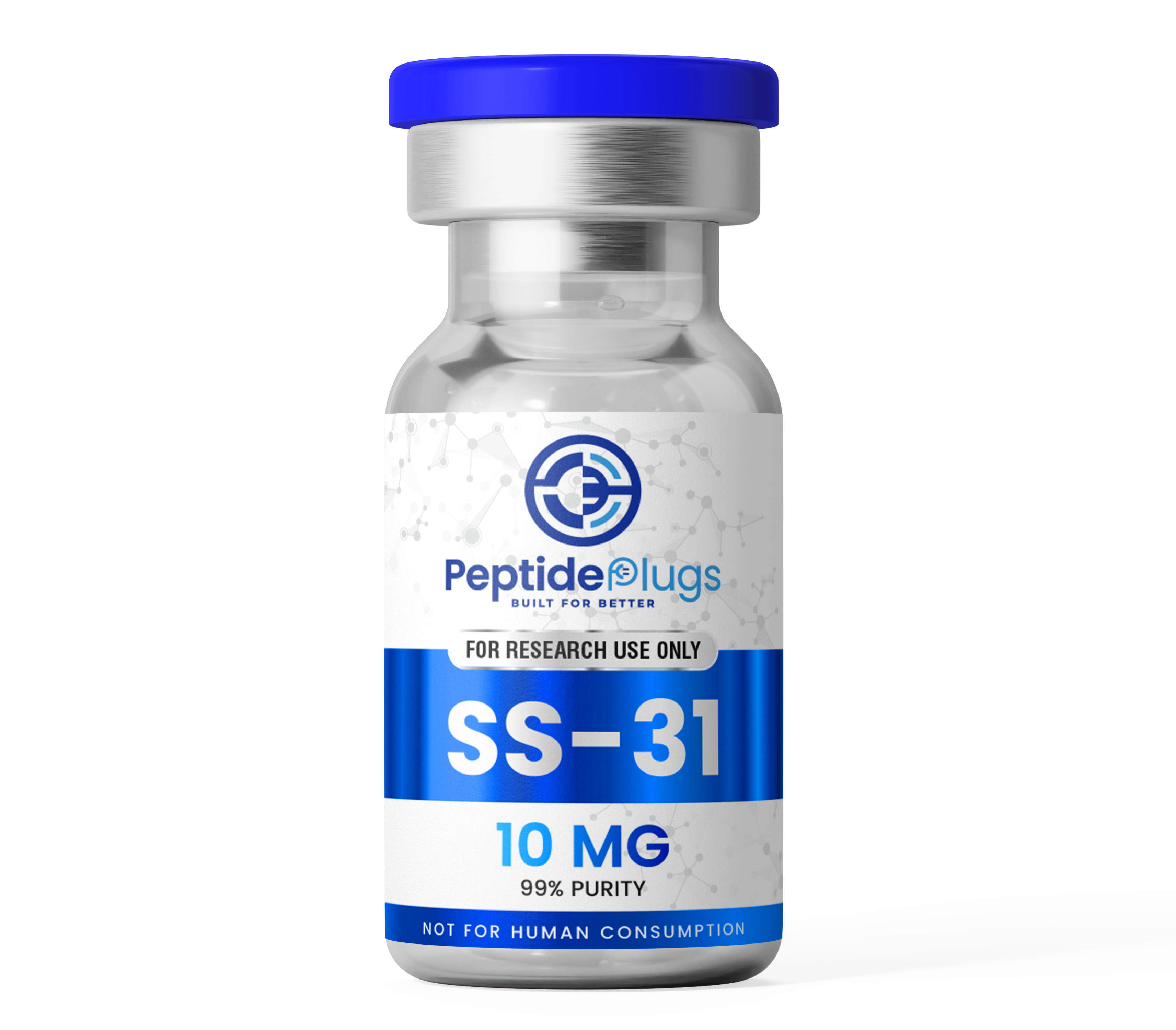
The small-run vial. The lowest spend to start on cardiolipin work.
A four amino acid peptide that concentrates at the inner mitochondrial membrane and binds cardiolipin. The 10mg vial is the smallest commitment of the three, sized for a pilot, a method check, or a short single-arm run.
The working vial. Five times the material at $2.00 a milligram.
A four amino acid peptide that concentrates at the inner mitochondrial membrane and binds cardiolipin. The 50mg vial is the larger research quantity for extended or multi-arm protocols, at 43% less per milligram than the 10mg.
The stock vial. The lowest price per milligram on SS-31.
A four amino acid peptide that concentrates at the inner mitochondrial membrane and binds cardiolipin. The 100mg vial is the most material in one place, for larger cohorts and long programs, at $1.80 per milligram, 49% less than the 10mg.
Pick a size here or in the buy panel. This page follows it, and the buy panel follows this.
- Pilot runs and method checks before committing to more material
- Short, single-arm work where a larger vial would sit unused
- Adding SS-31 to a mixed box: it counts toward the ten at 25% off
- Checking a lot against your own assay before scaling up
When to size up: five 10mg vials at the 5-pack rate run $131.25. One 50mg vial is the same 50mg for $100.
- Extended or multi-arm protocols that would go through several 10mg vials
- Fewer vials to reconstitute, label and log for the same material
- More room in one vial for repeat measurements across a run
- A 5-pack or 10-pack as stock, down to $1.20 per milligram
When to size up: two 50mg vials at the 2-vial rate run $190. One 100mg vial is the same 100mg for $180. When to stay here: two vials can be reconstituted apart, so the second stays lyophilized until it is needed.
- Larger cohorts and programs that use material in volume
- One lot for a whole study, so every arm draws on the same certificate
- The lowest cost per milligram: $1.80 single, $1.08 in a 10-pack
- Less vial handling when the total quantity is already planned
Before you choose it: a reconstituted vial has a limited window, so the 100mg suits work that will use it inside the period on the label. For a slower run, two 50mg vials keep half the material lyophilized for $10 more.
Ten 10mg vials at 40% off run $210, which is $21 a vial and $2.10 per milligram. The ladder is 2 vials 5%, 3+ vials 10%, 5-pack 25%, 10-pack 40%, off the single-vial price, applied in the cart. Any mixed box of ten vials across sizes or products takes 25% off.
Ten 50mg vials at 40% off run $600, which is $60 a vial and $1.20 per milligram. The ladder is 2 vials 5%, 3+ vials 10%, 5-pack 25%, 10-pack 40%, off the single-vial price, applied in the cart. Any mixed box of ten vials across sizes or products takes 25% off.
Ten 100mg vials at 40% off run $1,080, which is $108 a vial and $1.08 per milligram. The ladder is 2 vials 5%, 3+ vials 10%, 5-pack 25%, 10-pack 40%, off the single-vial price, applied in the cart. Any mixed box of ten vials across sizes or products takes 25% off.
The larger vial is the cheaper milligram, and the smaller vials buy flexibility: each one is reconstituted only when it is needed.
What It Is
SS-31 (elamipretide) is a synthetic four amino acid peptide from the Szeto-Schiller series, designed to concentrate at the inner mitochondrial membrane. It appears in the early literature as MTP-131 and Bendavia, and in clinical development as elamipretide. In September 2025 the FDA granted elamipretide accelerated approval as Forzinity for Barth syndrome, a narrow approval that does not extend to the research uses below.
How It Works
SS-31 binds cardiolipin, a phospholipid found almost exclusively in the inner mitochondrial membrane, where it shapes the cristae and holds the electron transport chain in the tight arrangement it needs to produce ATP. Research examines how that binding stabilizes the membrane under stress, keeps the respiratory machinery assembled, and reduces oxidative leak. Its uptake does not depend on membrane voltage, which sets it apart from earlier mitochondria-targeted antioxidants.
It does not add a new pathway. Research looks at how it restores the efficiency of one the cell already has.
One compound, one line to read. The lab record on this page gives an HPLC purity figure and a measured content for a specific lot, with the chromatogram behind it. Read the purity line, then check the lot number against the label on your vial.
Every lot is tested, and the certificate is replaced when a new lot goes on the shelf.
- Synthetic mitochondrial-targeted peptide, four amino acids
- Studied for cardiolipin binding at the inner membrane
- Researched for mitochondrial-function support
- Examined in oxidative-stress models
Research Context
The strongest human data is the Barth syndrome program behind the 2025 approval. Outside it, the record is preclinical and investigational: ischemia-reperfusion and heart failure models under the Bendavia name, mitochondrial energetics and fatigue resistance in aged mice, and investigational programs in primary mitochondrial myopathy, dry age-related macular degeneration, and diabetic kidney disease.
What's in the Vial
One lyophilized vial containing 10mg50mg100mg of SS-31, supplied for laboratory research use. Reconstitute with bacteriostatic water.
Storage
Lyophilized: store refrigerated, away from light. After reconstitution: keep refrigerated and use within the period indicated on the product label. Do not freeze reconstituted product.
- 10mg per vial
- Lowest total spend of the three sizes
- Pilot and method-check runs
- Mitochondrial-targeted peptide
- Lyophilized for shelf stability
- 50mg per vial
- $2.00 per milligram, $1.20 in a 10-pack
- Extended and multi-arm protocols
- Mitochondrial-targeted peptide
- Lyophilized for shelf stability
- 100mg per vial
- $1.80 per milligram, $1.08 in a 10-pack
- Larger cohorts on a single lot
- Mitochondrial-targeted peptide
- Lyophilized for shelf stability