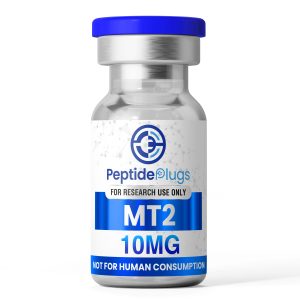
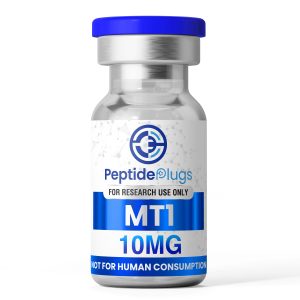
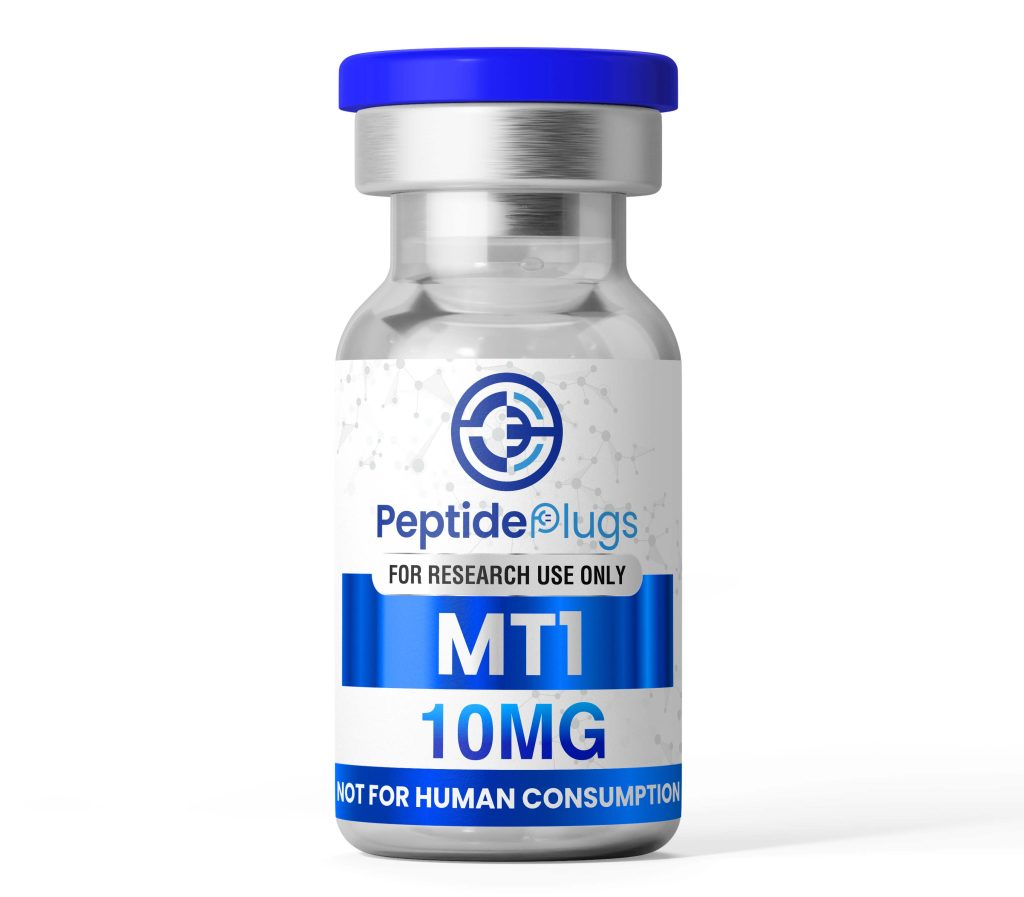
 Melanotan I 10mg
$40
97 in stock
✓ Third-party tested·✓ 99%+ Purity·✓ Same-day UPS Air Express
Same-day fulfillment from Texas · Ships free over $200 · Secure credit card checkout
Call or text 512-960-7885

 Lab tested 99.92% pure
For laboratory and research use only. Not for human or veterinary use, not a drug, food, or cosmetic.
A 10mg lyophilized vial of Melanotan 1, a synthetic analog of alpha-MSH researched for melanin production and UV photoprotection. The more receptor-selective of the two melanotans, studied for a cleaner systemic profile than MT2.
MT1 is Melanotan 1, a synthetic analog of the body's own alpha-MSH. It does one job: it activates the MC1R receptor on melanocytes, which tells those cells to produce more eumelanin. Because it is selective for MC1R, it largely stays out of the other melanocortin receptors that MT2 hits, which is why MT1 is the version researchers reach for when they want pigmentation effects with a quieter systemic profile.
MT1 (Melanotan 1) is a synthetic analog of alpha-melanocyte-stimulating hormone (alpha-MSH), with the formal designation [Nle4, D-Phe7]-alpha-MSH. The two amino acid substitutions in its sequence make it far more stable than natural alpha-MSH, which the body clears almost immediately. Those modifications let it stay active long enough to actually do something at the receptor.
The mechanism is direct. MT1 binds the melanocortin-1 receptor (MC1R) on the surface of melanocytes, the pigment-producing cells in skin. That binding raises intracellular cAMP, which activates tyrosinase, the rate-limiting enzyme in melanin synthesis. The end result is increased production of eumelanin, the darker, more photoprotective form of melanin. In effect, MT1 tells the skin to tan through the same pathway that natural sun exposure works through, but it triggers it pharmacologically rather than through UV damage.
What separates MT1 from its better-known sibling MT2 is selectivity. MT2 is a broad melanocortin agonist that also activates MC3R and MC4R, the receptors tied to appetite, libido, and the nausea and flushing many MT2 researchers report. MT1 is far more selective for MC1R, so its activity stays concentrated on pigmentation. It trades some of MT2's raw potency for a meaningfully cleaner profile.
The same pathway sunlight uses, triggered at the receptor instead of through UV damage.
This is the question almost everyone has, so here it is straight. MT1 and MT2 reach the same general endpoint, more pigment, but they get there differently and behave differently in practice.
One lyophilized vial containing 10mg of MT1 (Melanotan 1) at research-grade purity. Reconstitute with bacteriostatic water. Tested for purity by third-party HPLC analysis. COA available on this product page.
"Melanotan" is a contraction of melanocyte and tan, which is exactly what the molecule was designed to act on. The numbering separates the two analogs that came out of the original research at the University of Arizona. MT1 is the first and more selective of the two, refined into the clinical compound afamelanotide. MT2 is the broader, more potent analog that became more widely known in the community. When someone says "the melanotans," these are the two they mean, and MT1 is the cleaner, more targeted of the pair.
MT1 has the strongest clinical pedigree of any peptide in the melanotan family. Its active form, afamelanotide, is the basis of an approved prescription drug (marketed as Scenesse) used as a subcutaneous implant to provide photoprotection in erythropoietic protoporphyria, a rare condition where sunlight causes severe pain. That approval means MT1's core mechanism is unusually well characterized for a research peptide. The implant form approved for that narrow medical condition is not the same product as research-grade MT1 powder, and MT1 sold for research use is not FDA-approved for general human use. What the clinical history does provide is a far deeper mechanistic and safety literature than most research peptides can point to.
MT1 is most often used on its own, since its entire appeal is a focused, selective effect. Some researchers run it as the lower-side-effect alternative to MT2 outright. Others use MT1 alongside MT2 in protocols that want MT2's potency but lean on MT1 to carry part of the pigmentation load with less systemic burden. No published combination data exists at this level, and pairing the two melanotans is community-driven rather than formally studied.
Lyophilized: store refrigerated, away from light. After reconstitution: keep refrigerated, use within 30 days. Do not freeze reconstituted product. Protect from light at all stages.
Don't have an account yet? Sign up
No items in your cart. Go on, fill it up with something you love!
Start Shopping NowTap below to open your messaging app and text us directly.
Open MessagesText us anytime at the number below — or use the contact form on this page.
Save it to your phone and send us a text.
We set a big milestone goal for the month of August. Until we reach it, the entire store is 10% off. No code needed, the discount is applied automatically in your cart.
When the bar below hits 100%, the sale ends. Lock in your discount while it lasts.
The sale ends the moment this bar reaches 100%.
Melanotan I 10mgMelanotan I 10mgThe statements on this website have not been evaluated by the U.S. Food and Drug Administration. All products sold by Austin Research Products LLC (d/b/a PeptidePlugs) are intended strictly for laboratory research and development purposes only. These compounds are not drugs, supplements, or cosmetics, and are not intended to diagnose, treat, cure, or prevent any disease. Austin Research Products LLC (d/b/a PeptidePlugs) is a research material supplier - we are not a compounding pharmacy or compounding facility as defined under Section 503A of the Federal Food, Drug, and Cosmetic Act, nor an outsourcing facility as defined under Section 503B. Products are not for human or animal consumption. By purchasing from this site, you confirm you are a qualified researcher or licensed professional and accept full responsibility for the safe handling, storage, and use of all materials in compliance with applicable laws and regulations.