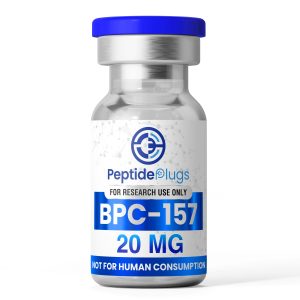
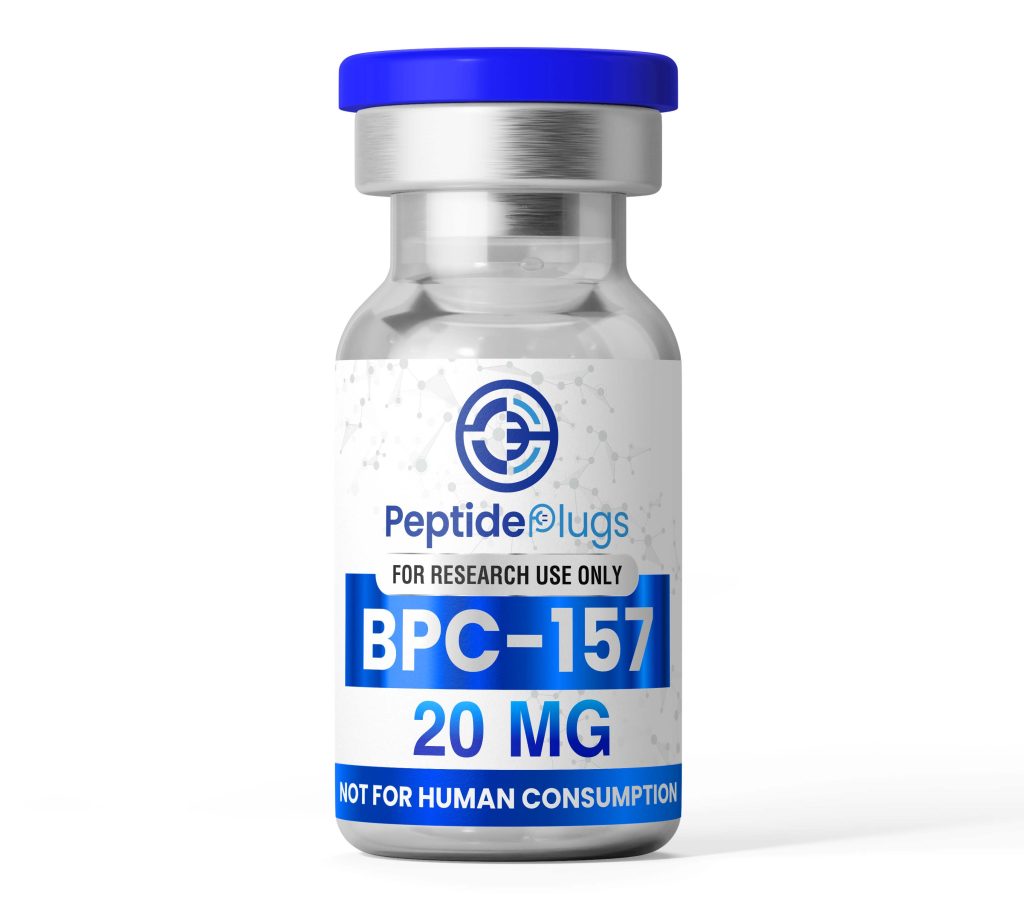
 BPC-157 20mg
$65
61 in stock
✓ Third-party tested·✓ 99%+ Purity·✓ Same-day UPS Air Express
Same-day UPS Air Express from Texas · Ships free over $200 · Overnight option available
Call or text 770-335-0683

 Lab tested 99.11% pure
For laboratory and research use only. Not for human or veterinary use, not a drug, food, or cosmetic.
A 20mg vial of pure BPC-157, the partial gastric protein sequence behind two decades of preclinical tissue-repair research. The most extensively studied peptide in the recovery space, on its own and undiluted.
BPC-157 stands out for the breadth of its research base. Where many peptides are studied in one narrow context, BPC-157 has been examined across connective tissue, muscle, the gut, and the vascular system. It works largely at the local site of injury, which is part of why researchers so often pair it with a systemic compound like TB-500.
BPC-157 is a synthetic peptide made up of a 15-amino-acid partial sequence derived from a protective protein found in human gastric juice. The name stands for Body Protection Compound. It does not occur in this exact form in nature; it is a stabilized fragment researchers isolated for its protective properties. Since the 1990s it has been the subject of an unusually large body of animal research, which is what built its reputation as the foundational compound of the recovery peptide category.
The defining characteristic of BPC-157 in the literature is that it acts largely at the site of injury rather than systemically. That localized action is why it is so often described as a targeted repair compound, and why it pairs naturally with peptides that work across the whole system.
These are the proposed mechanisms drawn from preclinical research. Together they describe a compound studied for building and protecting tissue at the local level.
One lyophilized vial containing 20mg of pure BPC-157. Reconstitute with bacteriostatic water. Tested for purity by third-party HPLC analysis. COA available on this product page.
BPC-157 has been studied in preclinical models since the 1990s, primarily in rodents, with research spanning tendon, ligament, muscle, and gastrointestinal repair. Despite the depth of that animal data, human clinical trials remain limited, and BPC-157 is not FDA-approved for human use. It is sold strictly as a research compound labeled for laboratory use. Researchers value it as much for its long literature trail as for its breadth, since it provides a well-documented baseline that newer peptides are often measured against.
The most common pairing is with TB-500, the combination known in research circles as the "Wolverine" stack, where BPC-157 covers the local injury site and TB-500 provides systemic coverage. Adding KPV brings an anti-inflammatory layer on top, the configuration sold as the Wolverine Plus blend. Extending further with GHK-Cu reaches toward connective tissue and skin pathways, which is the basis of a KLOW-style four-peptide blend. BPC-157 is also frequently run on its own as a clean baseline before researchers introduce other variables.
Lyophilized: store refrigerated, away from light. After reconstitution: keep refrigerated, use within 30 days. Do not freeze reconstituted product.
Don't have an account yet? Sign up
No items in your cart. Go on, fill it up with something you love!
Start Shopping NowTap below to open your messaging app and text us directly.
Open MessagesText us anytime at the number below — or use the contact form on this page.
Save it to your phone and send us a text.
BPC-157 20mgBPC-157 20mg